


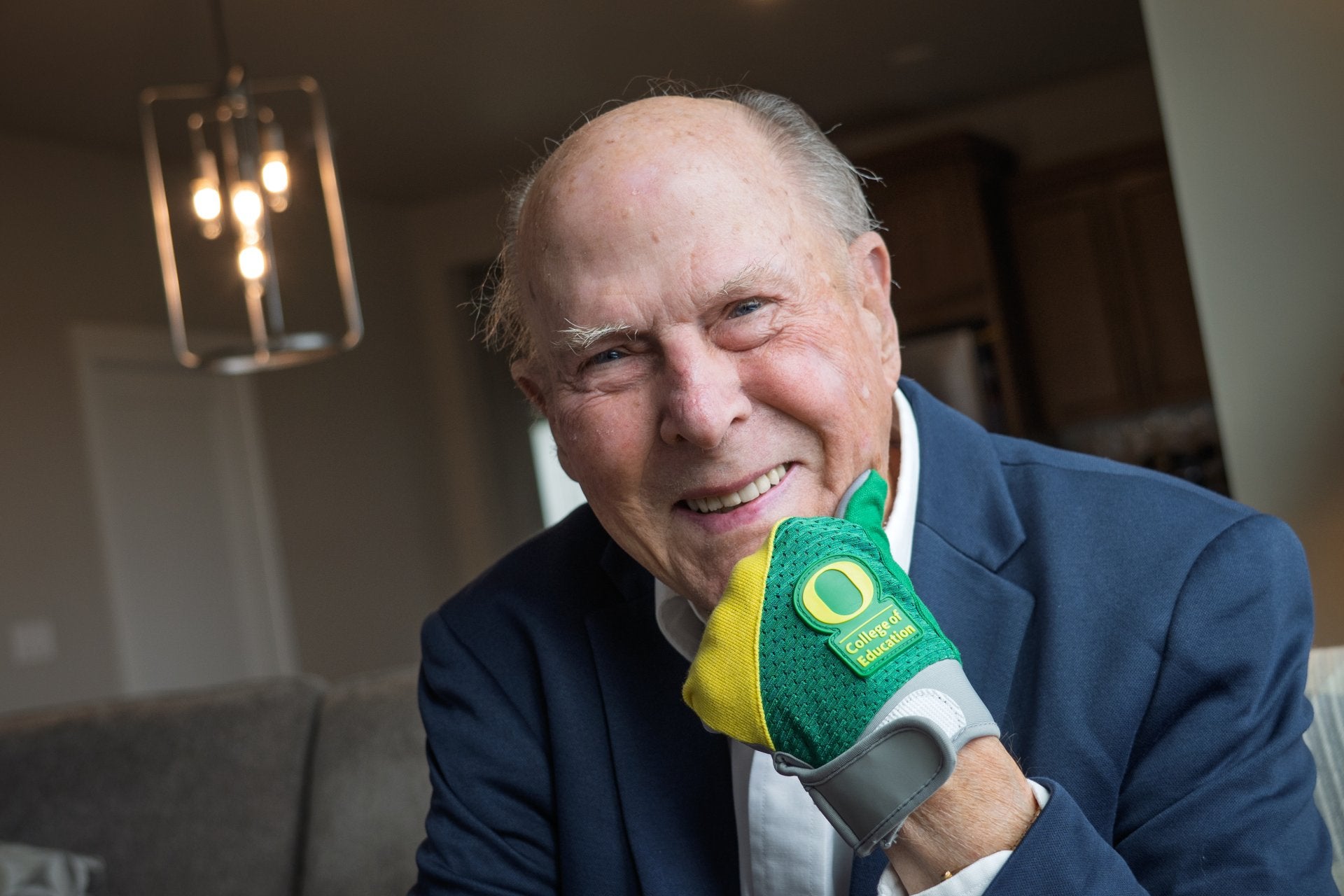
Looking outward as life changes: One donor's approach to planned giving
At 86, Alan Eliason is centering generosity in his life—supporting educators, bilingual classrooms, and UO students through planned giving.
Story by Korrin Bishop
Photos by Andy Nelson
Alan Eliason’s story begins in Lindstrom, Minnesota, a tiny, lake-hugged town known as “America’s Little Sweden” after Swedish emigrants settled it in the 1850s. His graduating class had just 36 students.
From those early years, curiosity and a love of learning pushed him outward. He went on to build a career spanning engineering, computing, teaching, writing, and mentoring. Today, at 86, that humble beginning shapes something else: his philosophy of giving.
“I’ve been very lucky in my life, and that sense of good fortune is a big part of why I give,” he said. “People have supported me from the very beginning, starting in that tiny class in Lindstrom and all the way through a university career that lasted 40 years. When I look back on it, it’s amazing.”
Alan calls it a shift in values, one he has felt personally, and one better fitted to this period in his life. With age came a deeper desire to help, to share, and to invest in others’ journeys.
“Older people go through a change in values, and I certainly have. Instead of being self-directed or inner-directed, I’ve become much more outer-directed. I don’t need more ‘stuff.’ I have everything I need. I don’t have a career to manage anymore, no lectures to prepare, no kids to raise. Now that I’m older and have some resources—not tremendous, but enough—I feel this courage to share. It’s a glorious feeling. Part of it is wanting to establish a legacy.”
Through the experiences that have shaped him—including two great loves—and his belief that small acts of support can change a life, Alan is now putting that legacy into action through his endowments and planned gifts to the University of Oregon.
Engineering, Curiosity, and the First Turning Point
Alan’s path began with early studies in pre-engineering at Gustavus Adolphus College, followed by mechanical and industrial engineering at the University of Minnesota. After these undergraduate years, he got his first job at DuPont as an industrial engineer.
“I didn’t like it. I was bored,” he admitted, so he returned to the University of Minnesota for a master’s degree. Upon completing it, he had an opportunity at just 25 years old to teach at California Polytechnic State University–San Luis Obispo, and he took it.
“I discovered my career needed to change from the corporate world to the university world,” he said, realizing that a higher education setting provided the intellectual space and human connection he craved.
After teaching for some time, he returned to the University of Minnesota for his doctoral degree, just in time to dive into a newly burgeoning field.
“At that point, they had something called a computer,” he laughed. “Though hardly anyone knew what it was.”
Back then, computers weren’t interactive in the ways they are today; programs had to be created using stacks of punch cards, each one representing a single line of code.
“My dissertation alone took 3,000 punch cards to develop, but it worked,” he remembers.
Finding Home in Oregon: A Place for Freedom and Innovation
After completing his PhD, Alan joined the UO as a professor in the College of Business, later serving as director of university computing as administrative dean.
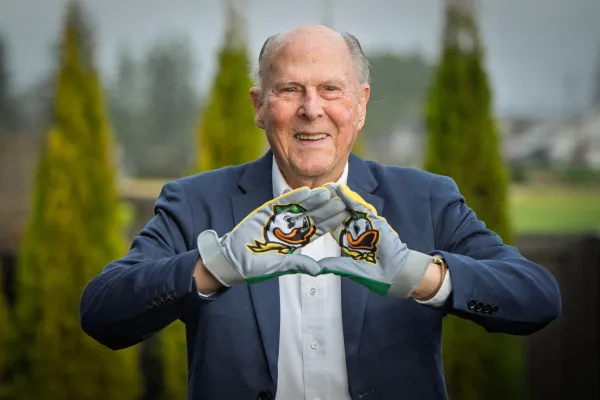
He then spent two years teaching at the University of Calgary before returning to Eugene, where his wife, Jane Eliason, MS ’82, pursued a degree in speech and language in the College of Education. Alan stayed home with their son and focused on writing.
Eventually, he returned to teach at the UO in computer science, where software engineering quickly became his favorite course.
“It was marvelous fun dealing with the very brightest students in Oregon, just unbelievable,” he remembered.
His classes became legendary. Students worked in teams, partnered with real clients, and selected their own projects.
“I asked them ‘What do you want to build?’ I didn’t tell them. They told me.”
The results were often ahead of their time. One group designed a diver’s watch system to track oxygen levels. Another built a therapeutic game for hyperactive children where the only way to win was to slow down.
“We were developing things that nobody thought were possible,” he said.
For Alan, these moments weren’t just academic triumphs but confirmations of the power of curiosity and good mentorship.
But perhaps the most defining choice of his UO career came shortly after earning tenure: he gave it up.
“I didn’t want it to define what I did,” he explained.
Without those constraints, he leaned even further into experimentation. He wrote 25 books and as many articles, tried new technologies, designed creative and student-led coursework, and still found time to ski and coach soccer.
“Oregon provided me with a very good place to work,” he reflected. “We live in paradise. It’s a lovely state with lovely people.”
Partnership, Purpose, and Honoring Jane
Behind many chapters of Alan’s life was his first wife, Jane. They met when he was in graduate school, often walking to the same parking lot.
“On one of the walks, I said, ‘hey, do you accept dates?’” he laughed. “And that was it. She was very, very devoted to others—the kind of person you would really like.”
Jane built a meaningful career working with at-risk students in Cottage Grove and Springfield, and her compassion left a lasting mark on Alan. When she was once assigned an entire class of students in individualized education programs, her response was unexpected and transformative.
“She came home and she said, ‘I’m going to teach them poetry,’” Alan recalled. “I still have copies of the poetry. It’s some of the hardest poetry I’ve ever read, but it really impacted the students.”
Alan remembers how when one of those students was later sent to juvenile detention, he asked for a pen and paper because he wanted to write poetry.
“She gave them a way to express some of those feelings that are never let out,” he said.
After Jane passed away, Alan knew he wanted to honor her life’s work. He established the Jane Eliason Fund in Communication Disorders and Sciences, which helps support graduate students during their unpaid practicums—the moment when financial strain is greatest. Many students must still pay tuition while covering transportation costs, professional attire, and licensing fees.
“These students are often barely making it to the end,” he said. “They need just a little help.”
For Alan, the purpose mirrors Jane’s belief in meaningful, well-timed encouragement.
“What we don’t do enough in this country is give small awards. We should give these students something to show them that what they’ve accomplished is valuable.”
In addition to the gift that established the fund, the remainder of Alan’s charitable gift annuities (CGAs)—agreements that pay him income for life and leave the remainder to the UO—will continue to support it long into the future, extending his and Jane’s legacy of care.
A Second Love, A Second Legacy: Supporting Bilingual Educators
Before she passed, Jane told Alan he shouldn’t be alone, that he should eventually find someone to share life with. Several years later, he married Charlotte Sahnow, BA ’66, MA ’91, PhD ’95, a French professor at the UO who had joined the couple on ski trips years earlier.
Their partnership was rooted in shared intellectual interests, skiing, travel, and a rich exchange of ideas, but their years together were cut short. After five years, Charlotte developed dementia, and Alan cared for her through the next five.
“Dementia is just awful,” he shared.
Still, before her illness began, the two made thoughtful plans to ensure her passion lived on. Together, they created the Charlotte Sahnow Scholarship for Bilingual, Dual Language, and ESOL Educators, supporting students pursuing bilingual and multilingual teaching credentials at a time when linguistically diverse classrooms are rapidly expanding nationwide.
As with Jane’s fund, the remainder of Alan’s CGAs will support this scholarship into the future. Through both gifts, he honors the women who shaped his life and continues the work they dedicated themselves to—helping others communicate, learn, and thrive.
Gratitude for a Life Well Lived
Alan often reflects on how his values have shifted with age.
“I have everything I need,” he said. “I don’t need as much for myself anymore.”
With that realization came a new purpose: to live outwardly rather than inwardly, to direct his resources not toward himself but toward those who need them most.
He has witnessed the full sweep of Oregon—the brilliance of students pushing boundaries in his classrooms, and the hardship faced by young people navigating instability, hunger, and limited access to education. That contrast sharpened his conviction that no one should be hungry here, that every student deserves opportunity and recognition, and that the environment must be protected for the generations to come.
Planned giving allows him to live that outward-focused philosophy with intention. By establishing funds that will continue beyond his lifetime, Alan is redistributing what he has so others may flourish.
Still, he walks every day, reads widely, and nurtures the curiosity that has guided him since Lindstrom.
“I’m still having fun,” he smiled.
Age, to him, is only a marker. What he feels most is gratitude—for opportunity, for education, and for a life shaped by community and love. And so, he gives in return.
Join Alan in paying it forward to the UO today by exploring planned giving options or by making a donation.