


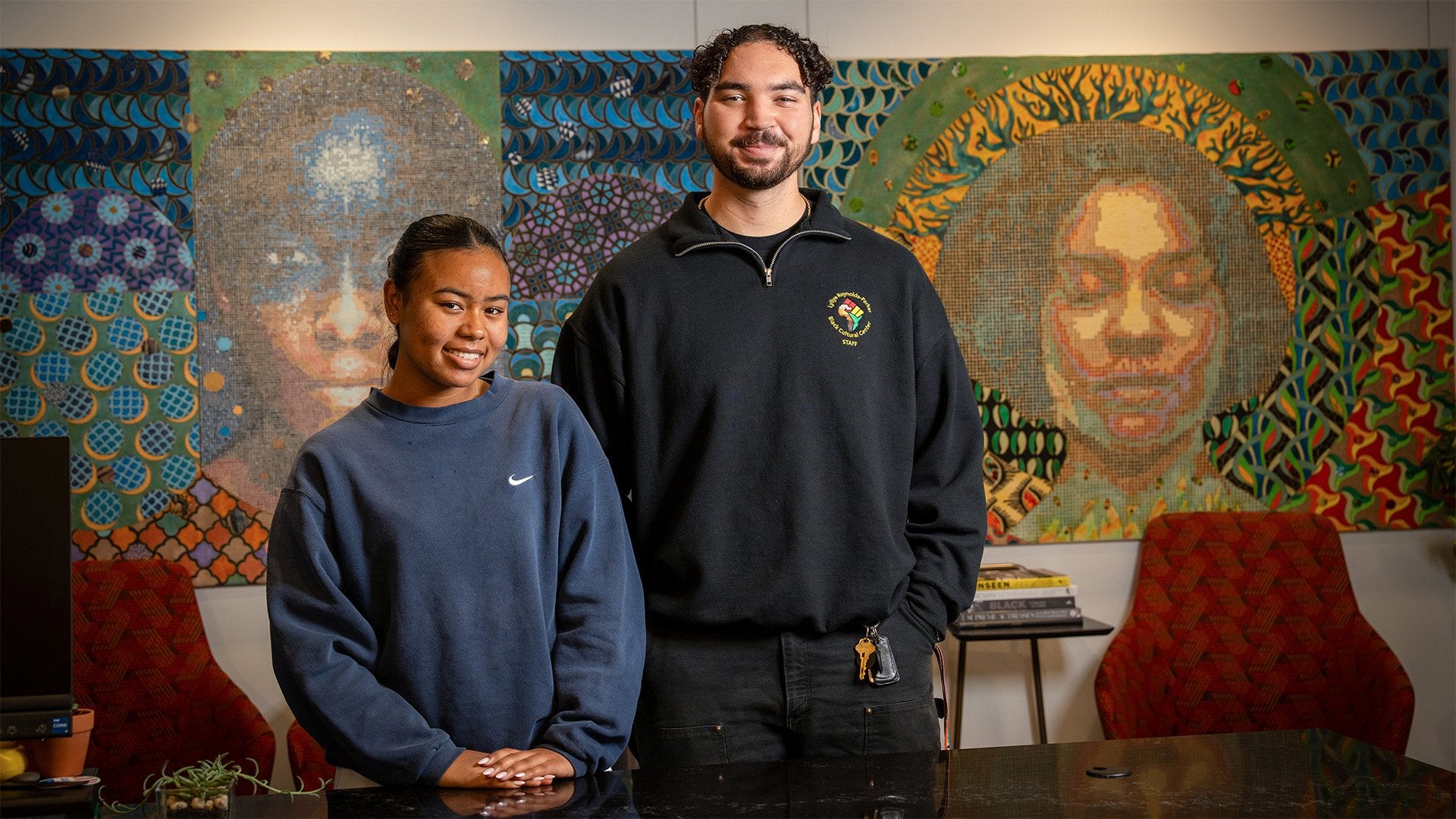
Meet the student leaders behind the BCC
Fayola Beck, class of 2026 (human physiology), and Walker Hicks, class of 2025 (business), are leadership and outreach program associates for the BCC and passionate advocates of its efficacy.
Story by Sage Kiernan-Sherrow
Photos by Andy Nelson
The Black Cultural Center (BCC) is not usually the reason that students come to the University of Oregon—but it is the reason that many of them stay. That was the case for Fayola Beck, class of 2026 (human physiology), and Walker Hicks, class of 2025 (business), two students from the Bay Area who would have transferred out of the UO had it not been for the community they found in the BCC.
Beck always knew that she wanted to go to a college with Division 1 athletics and pursue her dream of becoming an athletic trainer, while Hicks fell in love with Oregon’s climate and its proximity to the great outdoors. Attending a school focused on embracing diversity was important for them, but they were left feeling isolated after realizing that the UO was a predominately white institution (PWI) during their first year. “I’ve always been the only Black girl,” Beck explains. When she joined the Gamma Phi Beta sorority, Beck and her peers took a poll where they were asked what the first thing people notice about you is. Whereas her sorority sisters overwhelmingly chose body size, Beck was the only person to highlight skin color. It made her feel like her peers couldn’t relate to her lived experiences.
Hicks also endured his fair share of colorism—prejudice or discrimination against individuals with a dark skin tone, typically among people of the same ethnic or racial group—on campus. As a phenotypically lighter Black man, he didn’t always feel like he had space to be his authentic self.
“It's challenging to interact with other Black students who are also having to fight to protect their own identity,” Hicks says.
Though the statistics are changing—UO just welcomed its most diverse class in history—the university’s Black student population has been slow to grow and Black faculty and staff have a noticeably high turnover rate. The university’s new strategic plan, OregonRising, aims to address these issues by recruiting and retaining top student and faculty talent and creating a flourishing community. The BCC is an essential partner in that goal.
Beck and Hicks’s became involved at the BCC completely by chance. Today, they are program associates for the center, through which they partner with Black student organizations to provide community, resources, and academic guidance, and put on impactful events. Hicks was the 2024 Association for Black Cultural Centers Undergraduate Student of the Year for his support of Black students on and off campus. He calls working for the BCC “rewarding, but also challenging.”
“You get used to rejection,” Hicks explains. “Students either don’t know that they might want that kind of resource, or they’re just already so comfortable in White spaces that they might not need it. That’s why I’m passionate about looking for people who might not necessarily fit in and trying to reach them.”
Beck says one of their biggest obstacles is keeping their community engaged as a building on the outskirts of campus.
“People don't really know about the space or the resources no matter how much we advertise or talk to them. The hard work is paying off, but it's hard to keep that retention up,” she says.
Hicks believes he has a solution—making the BCC and the Many Nations Longhouse, a similar cultural-affinity based building for Native students, mandatory spots on campus tours. He would also like to see the BCC have a meal program for students in the future, while Beck wants to partner more with the sports teams on campus.
“If you really care about students, you’ll bring them here,” Hicks says. “Anything they're searching for, we have it here. They just have to come. We have a fully stocked food pantry . . . It's just a great spot to hang out, be in community with one another.”
Some of Beck and Hicks’s favorite events are Super Soul Tuesdays, which provide academic support by bringing together Black students and faculty, and Wellness Wednesdays, which offer wellness support therapy services with Dr. Gadson. “Dr. Gadson is the best. I talked to her about my struggles freshman year and still do. She’s a great resource that I think every student should take advantage of,” Hicks says.
As Beck and Hicks approach graduation, they acknowledge that the future is intimidating, but are excited to see what it brings.
“I'm looking forward to new opportunities to embrace the challenge head on and not psych myself out too much. So just taking it day by day and like trying to find what I enjoy, what makes me happy,” Hicks says. “I know I would maybe like to do something similar to what I'm doing here. I think having this experience has really helped me grow as a person and learn about what I can do to control my own life and how I view the world.”
Both students will never forget the impact that the BCC has had on their college experience and lives.
“This is the first place where I found community . . . a home away from home,” Beck says. “I really consider them part of my family and didn’t realize how important they were until all the seniors started graduating and I started crying. I want all the other students to have that same sense of familiarity with everyone in here.”